
Nano Materials

In Situ Liquid TEM enables real-time visualization of nanoscale processes in liquid environments, including nanoparticle nucleation, growth, coalescence, diffusion, corrosion, and electrochemical reactions. Combined with EDS, EELS, and electron diffraction, it provides simultaneous structural and chemical information, offering unprecedented insights into dynamic phenomena governing nanomaterial synthesis and evolution.
Tracking the Formation of Pt₃Ni–Ni(OH)₂ Core–Shell Structures at the Gas–Liquid Interface by In Situ Liquid TEM
Using in situ liquid-cell TEM, the formation and evolution of Pt₃Ni–Ni(OH)₂ core–shell nanostructures at the gas–liquid interface were directly monitored in real time.
A mixed precursor solution containing Pt and Ni in DMF was introduced into the liquid cell under ambient air conditions. During the reaction process:
1. A Pt₃Ni alloy core was initially formed.
2. A Ni-rich shell subsequently developed around the Pt₃Ni core.
3. Trace moisture carried into the liquid cell from the surrounding air participated in interfacial reactions. At the gas–liquid interface, water molecules reacted with the outer Ni shell, resulting in the formation of a β-Ni(OH)₂ layer.
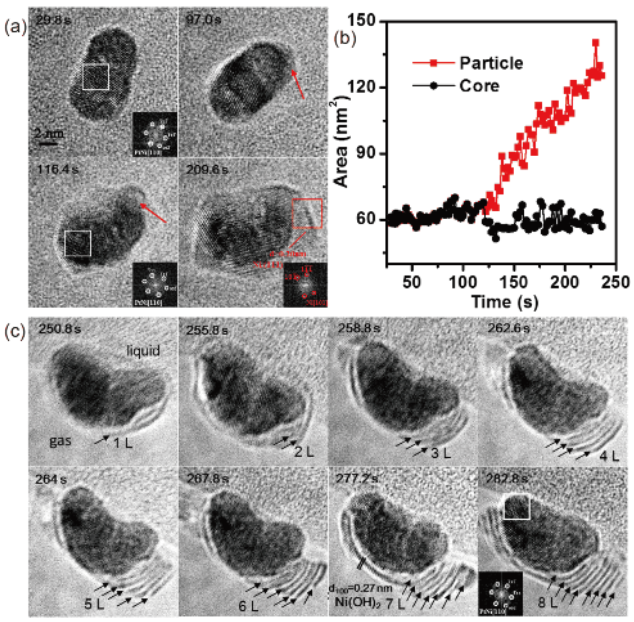
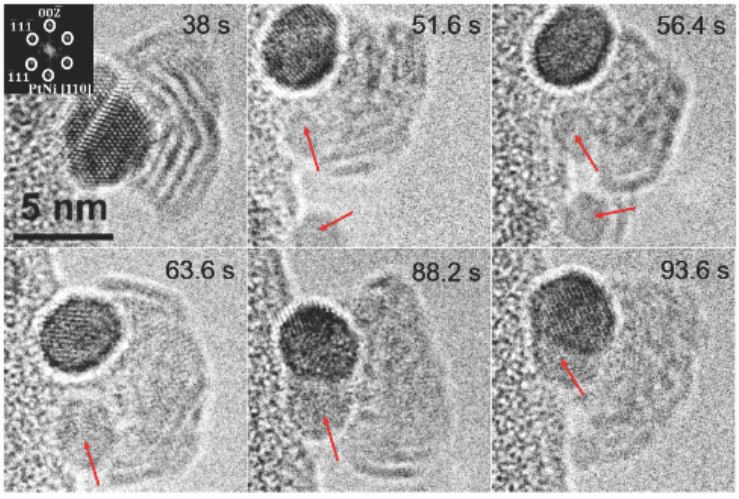
J. Zhang, G. Li, H.-G. Liao, S.-G. Sun, Tracking the atomic pathways of Pt3Ni-Ni(OH)2 core-shell structures at the gas-liquid interface by in-situ liquid cell TEM. Science China Chemistry, (2020).
In Situ Liquid TEM Study of Pt₃Fe Nanorod Growth
The growth of colloidal nanocrystals through nanoparticle attachment has been proposed as an alternative pathway to the conventional monomer-addition mechanism. However, the microscopic processes governing nanoparticle-mediated growth remain poorly understood.
In this study, in situ liquid-cell transmission electron microscopy (TEM) was employed to directly visualize the solution-phase growth of Pt₃Fe nanorods assembled from nanoparticle building blocks. Real-time observations revealed that anisotropic nanorods form through the attachment of shape-directed nanoparticles, followed by particle alignment, structural straightening, and shape correction, ultimately yielding single-crystalline Pt₃Fe nanorods. In addition, winding chains of polycrystalline nanoparticles were observed as intermediate growth structures.
By tracking individual nanoparticle trajectories during growth, the interaction forces acting between isolated nanoparticles and nanoparticle chains were quantitatively distinguished. These findings provide direct insight into nanoparticle attachment mechanisms and growth pathways, advancing the understanding of nonclassical crystal growth.
The ability to quantify nanoparticle interactions and visualize nanocrystal assembly in real time is of significant importance for the rational design of hierarchical nanomaterials and the controlled self-assembly of functional nanostructures.
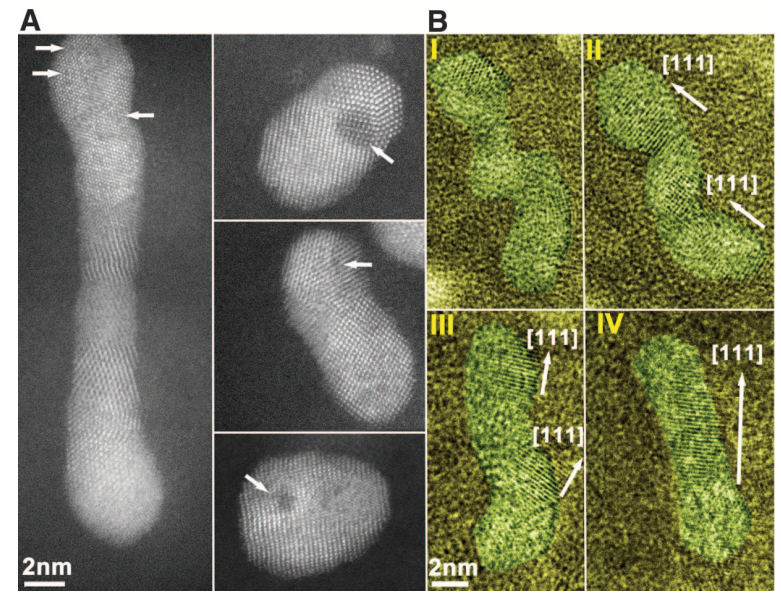
Liao, H.-G., Cui, L., Whitelam, S. & Zheng, H. Real-Time Imaging of Pt3Fe Nanorod Growth in Solution. Science 336, 1011, doi:10.1126/science.1219185 (2012).
In Situ Liquid TEM Observation of Pt Nanocube Growth
The growth of platinum nanocubes in a liquid environment was investigated using in situ liquid-cell transmission electron microscopy (TEM) with high spatial and temporal resolution. Real-time imaging enabled direct visualization of the nanocrystal growth process and facet evolution during particle formation.
The experimental results revealed that all low-index crystal facets exhibited comparable growth rates during the early growth stage. However, growth on the {100} facets eventually ceased, while the remaining facets continued to grow, leading to the formation of well-defined Pt nanocubes.
Complementary theoretical calculations indicated that the growth arrest of the {100} facets originated from the lower mobility of surface ligands on these facets. The reduced ligand dynamics inhibited further atomic attachment, thereby stabilizing the {100} surfaces and promoting the development of cubic morphology.
This study provides direct insight into facet-dependent growth kinetics and ligand-mediated shape control mechanisms, demonstrating the capability of in situ liquid TEM to reveal nanocrystal growth pathways at the nanoscale.
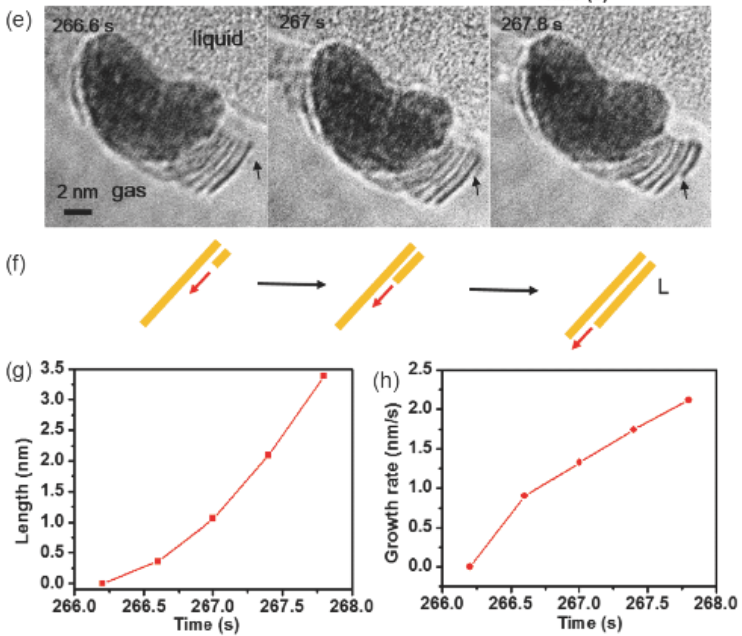
Hong-Gang Liao et al. Facet development during platinum nanocube growth.Science 345, 916 (2014);
In Situ Liquid TEM Study of Pt Superlattice Assembly and Symmetry Transformation
Two-dimensional (2D) nanocrystal superlattices with precisely controlled structures are of great importance for photonic, plasmonic, and optoelectronic applications and have been extensively studied. However, challenges remain in understanding the formation mechanisms and developmental pathways of these superlattices.
In this study, liquid-cell transmission electron microscopy (TEM) was used to directly observe the formation of Pt 2D superlattices and the local phase transformation from six-coordinated to four-coordinated structures. As colloidal nanocrystals flowed in solution, long-range ordered six-coordinated superlattices formed through nanocrystal contraction and rearrangement or through nanocrystal attachment.
When the morphology of the nanocrystals changed from truncated octahedra to cubes, the six-coordinated superlattice rearranged into a four-coordinated cubic superlattice. Furthermore, the observations and quantitative analysis showed that the phase transformation from six-coordinated to four-coordinated structures was mainly driven by strong van der Waals interactions between opposing {100} facets.
Real-time tracking of the formation of 2D cubic superlattices provides unique insights into the assembly and stabilization mechanisms of nanocrystal superlattices.
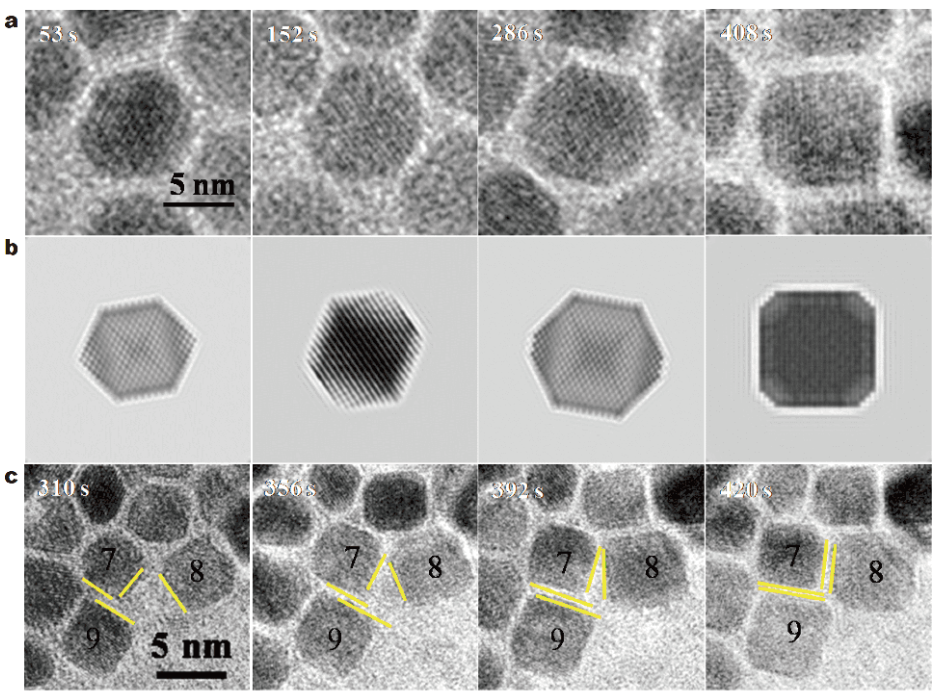
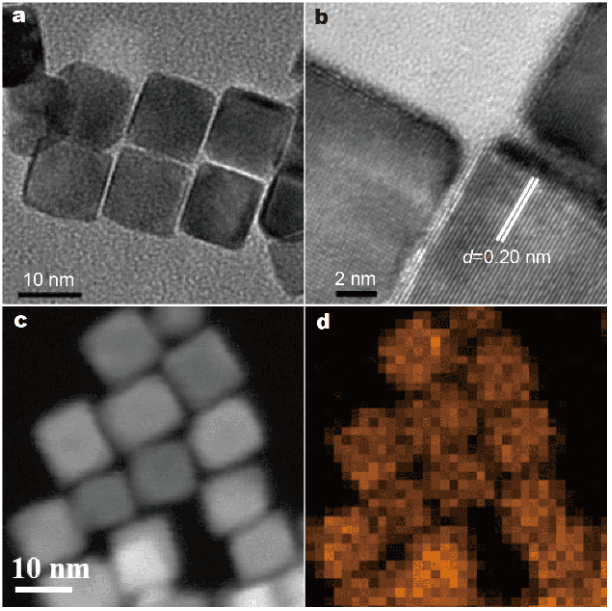
Junyu Zhang, Shi-Gang Sun and Hong-Gang Liao In-situ liquid cell TEM investigation on assembly and symmetry transformation of Pt superlattice. SCIENCE CHINA Materials.