Metal material

Application Examples
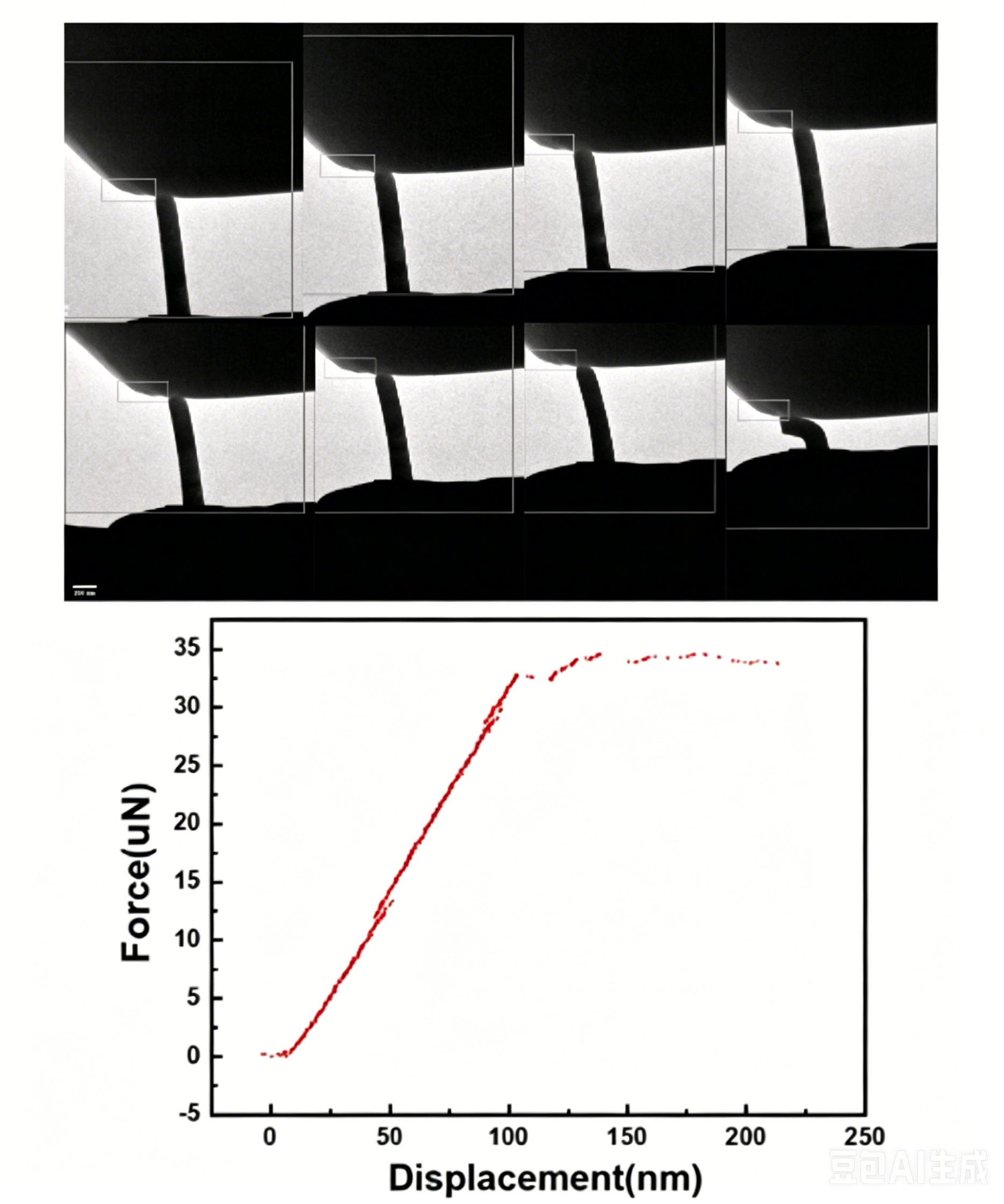
In Situ TEM Nanomechanical Compression of Cu Nanopillars at 600 °C
Microelectromechanical systems (MEMS) and nanoscale devices have attracted increasing attention due to their miniature dimensions and unique mechanical properties. However, conventional tensile and compression testing methods face significant challenges when applied to samples with dimensions below 100 μm. Nanocompression testing has therefore emerged as a powerful technique for investigating mechanical behavior at micro- and nanoscale dimensions.
In this study, in situ TEM nanomechanical compression experiments were performed on single-crystalline Cu nanopillars at 600 °C to investigate their deformation behavior and the influence of crystal defects on the onset of plasticity. Real-time observations revealed that Cu nanopillars exhibited a significantly higher degree of elastic deformation during compression compared with their bulk counterparts.
The effects of surface morphology and structural defects on the initial plastic deformation behavior were further examined. Nanoscale surface defects were introduced through thermal treatment, and comparative compression experiments demonstrated that these defects strongly influence the initiation of plastic deformation.
Simultaneous TEM characterization of the deformation region revealed the formation of various crystal defects, including dislocations, stacking faults, partial dislocations, and dislocation loops. The coexistence of these defect structures indicates that the onset of plastic deformation in Cu nanopillars is closely associated with dislocation nucleation and evolution mechanisms.
This work provides direct insights into high-temperature nanoscale deformation behavior and demonstrates the capability of in situ TEM nanomechanical testing for investigating the fundamental mechanisms governing plasticity in metallic nanostructures.
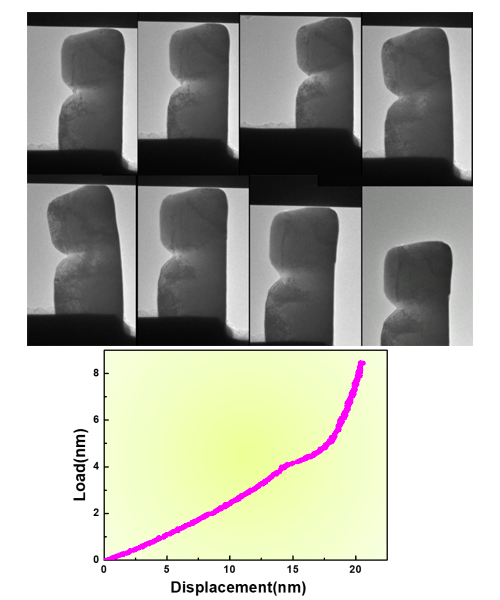
In Situ TEM Compression of Tungsten Nanopillars
The mechanical behavior of materials at micro- and nanoscale dimensions can differ significantly from that of bulk materials. To investigate deformation mechanisms under confined dimensions, in situ TEM nanomechanical compression testing was performed on tungsten (W) nanopillars, enabling simultaneous mechanical loading and real-time microstructural observation.
During compression, the evolution of deformation processes was directly monitored with nanometer-scale spatial resolution. The experiments revealed the initiation and propagation of crystal defects, including dislocation activity and localized plastic deformation. Quantitative force–displacement measurements, combined with real-time TEM imaging, provided direct correlations between mechanical response and underlying microstructural evolution.
The study demonstrates the capability of in situ TEM nanomechanical testing to capture nanoscale deformation dynamics, offering valuable insights into size-dependent mechanical properties, defect-mediated plasticity, and failure mechanisms in refractory metallic nanostructures.