

Growth crystal

Introduction
The controlled synthesis of nanocrystals with tailored morphologies and dimensions remains a central topic in nanomaterials research. Precise control over nanocrystal shape, size, structure, and composition is essential for optimizing their functional properties and enabling practical applications. Researchers aim to understand and regulate nanocrystal growth processes, allowing crystal development to be halted at desired stages and thereby achieving predictable material characteristics.
Nanocrystals encompass a wide range of materials, including metallic nanocrystals, oxide nanocrystals, and semiconductor quantum dots. Quantum dots are semiconductor nanocrystals typically smaller than 10 nm in size. According to classical nucleation and growth theory, nanocrystal growth is generally governed by two primary mechanisms: surface reaction-controlled growth and monomer diffusion-controlled growth.
Application Example
In Situ Observation of Gold Dendrite Growth in a Room-Temperature Solution with a 100 nm Liquid Layer Thickness
Observation of the Effects of Fluid Flow and Diffusion on Crystal Growth Morphology
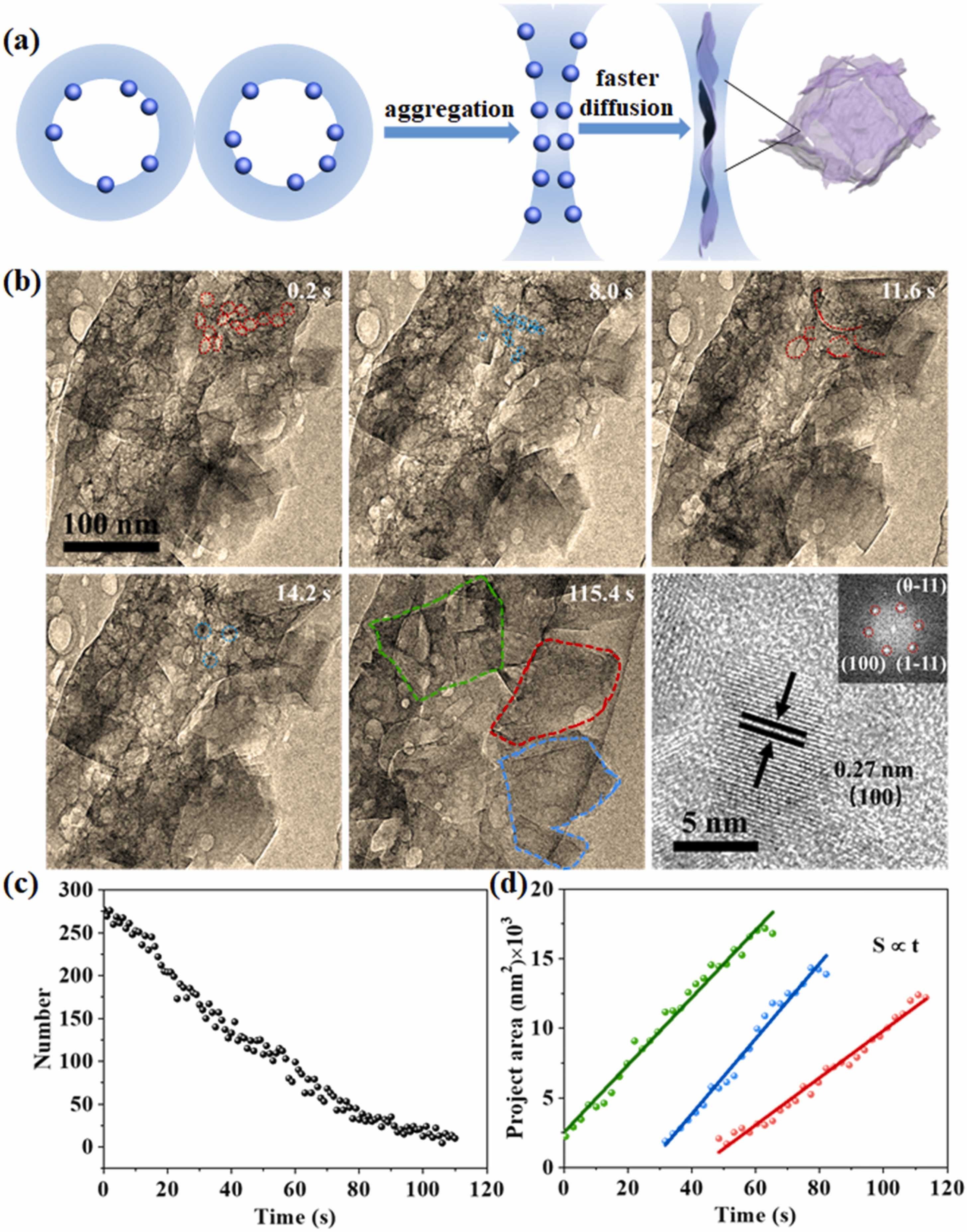
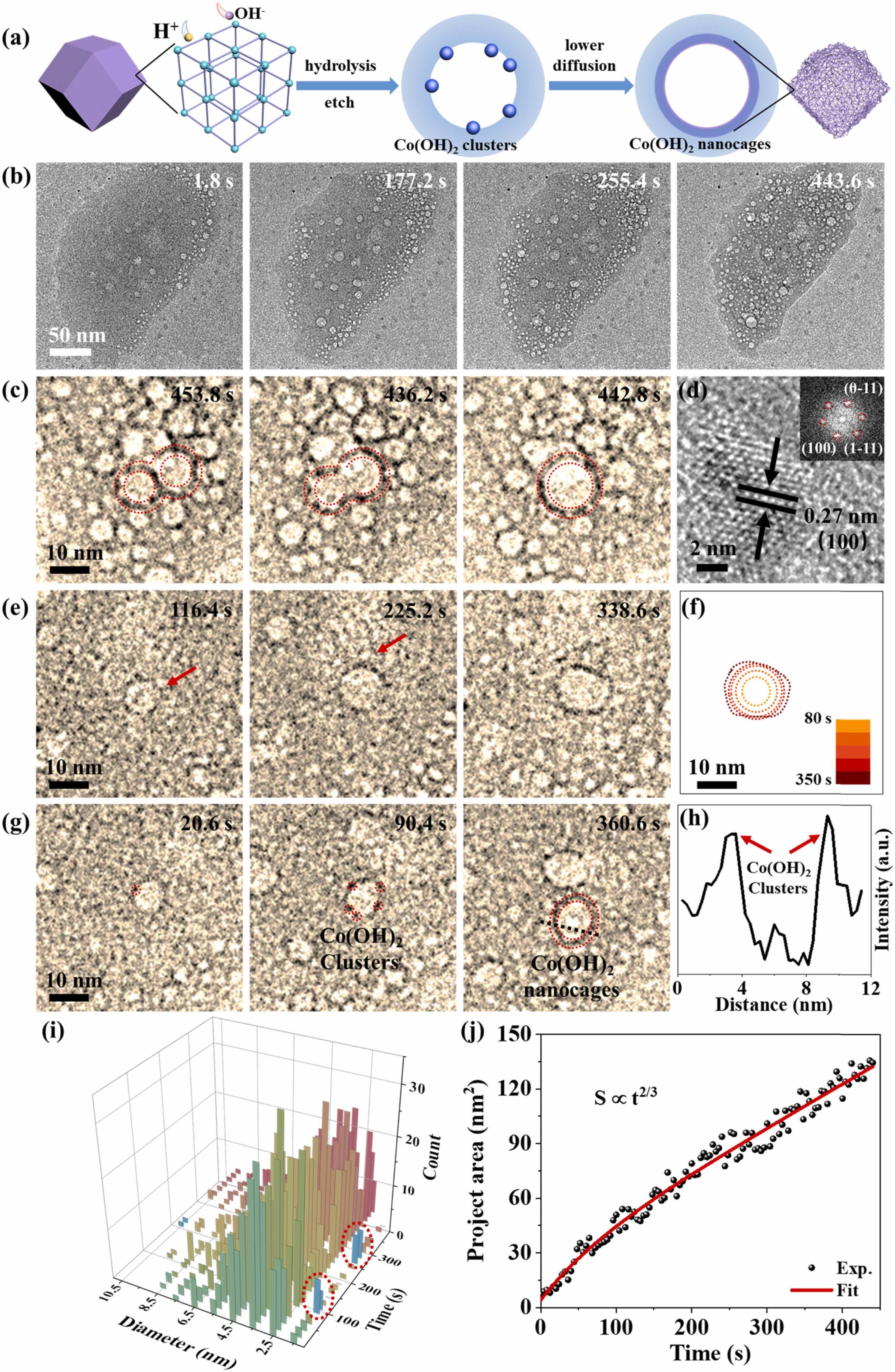
We directly visualized the etching process of metal–organic frameworks (MOFs). For the first time, we identified the unexpected role of nanobubble stability in controlling the transformation of ZIF-67 into porous or layered cobalt transition metal hydroxides (Co-TMHs).
As a result of structural collapse, voids within the MOF migrated and merged to form nanobubbles. Under slow diffusion conditions, nanobubbles moved gradually, and Co-TMH clusters formed at the nanobubble interface, further promoting the formation of internal nanocages and porous structures.
In contrast, rapid diffusion led to the rapid generation, aggregation, and reshaping of nanobubbles, thereby inducing the formation of layered structures.
Xiao L, Wang G, Huang X, et al. Efficient CO2 reduction MOFs derivatives transformation mechanism revealed by in-situ liquid phase TEM[J]. Applied Catalysis B: Environmental, 2022, 307: 121164.
Discovery of New Growth Modes in the Liquid-Phase Synthesis of Two-Dimensional Materials: Three-Dimensional Growth and Atomic-Layer Exfoliation
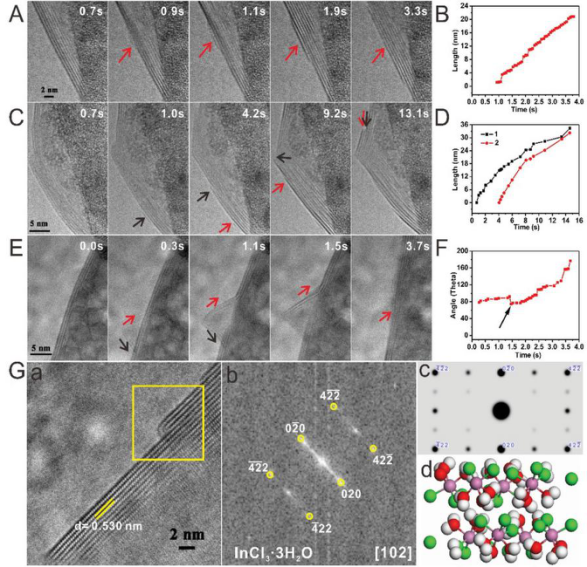
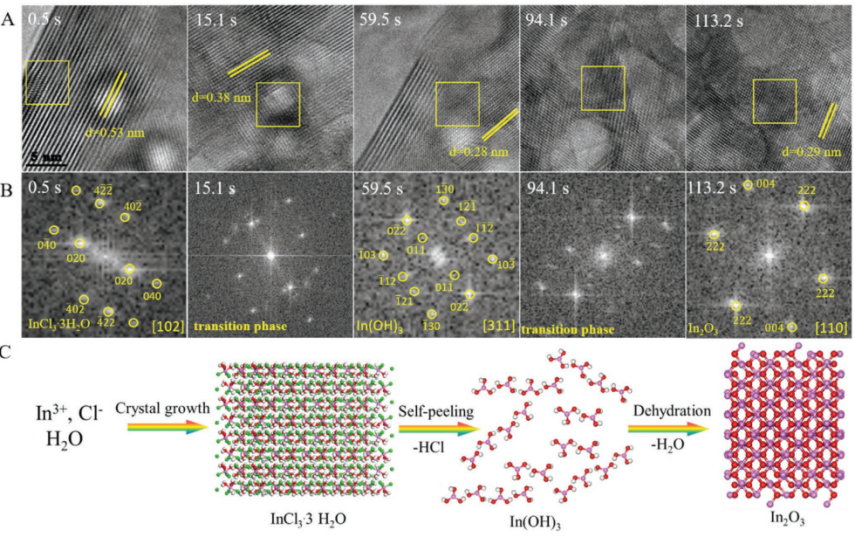
Liquid-phase transmission electron microscopy (TEM) was used to track the formation of ultrathin In₂O₃ nanosheets in solution at the atomic scale. The observations revealed that the formation of few-atomic-layer nanosheets undergoes a complex phase transformation process from InCl₃·3H₂O to In(OH)₃ and finally to In₂O₃.
Interestingly, the intermediate InCl₃·3H₂O nanosheets can form either through layer-by-layer growth or through strain-driven generation from the precursor solution. In addition, the in situ TEM results and density functional theory (DFT) calculations indicate that oleylamine is responsible for the self-exfoliation process.
These findings provide atomic-scale insights into how two-dimensional nanomaterials grow and transform in solution.
Zhang J, Jiang Y, Fan Q, et al. Atomic Scale Tracking of Single Layer Oxide Formation: Self‐Peeling and Phase Transition in Solution[J].
Small Methods, 2021, 5(7): 2001234.