
New energy

Whether for lithium-ion batteries, fuel cells, catalysts, photovoltaic materials, or other energy-related systems, our in situ solutions enable researchers to investigate, evaluate, and develop new technologies to meet the growing global demand for energy. By integrating advanced in situ electron microscopy techniques, users can directly image and quantify the performance of nanobatteries, catalysts, piezoelectric materials, photoactive materials, and volatile materials under realistic operating conditions.
A major challenge in energy research is developing operando characterization methods capable of revealing nanoscale structural and chemical changes occurring during energy conversion and storage processes. These changes often take place at electrode surfaces, electrode–electrolyte interfaces, and other internal interfaces that critically influence device performance and lifetime.
Electrochemical energy storage and conversion systems, such as rechargeable batteries and fuel cells, convert chemical energy into usable electrical energy for applications ranging from portable electronics to electric vehicles. In rechargeable lithium-ion batteries, lithium ions shuttle between the anode and cathode through insertion, conversion, or alloying mechanisms within a liquid electrolyte. Repeated charge–discharge cycling induces complex electrochemical reactions that lead to structural and chemical evolution of the electrodes and the solid electrolyte interphase (SEI). Similarly, fuel cells rely on electrocatalysts to convert hydrogen into electrical energy through a series of electrochemical oxidation and reduction reactions. The performance degradation of these systems is often associated with the stability of catalysts, support materials, and interfacial structures. Understanding the fundamental mechanisms governing these degradation processes is essential for the development of next-generation energy technologies with higher energy density, improved efficiency, and longer service life.
During electrochemical measurements, complex interfacial processes occurring within the electrodes and liquid electrolyte can be simultaneously monitored using TEM and STEM imaging, electron diffraction, and advanced spectroscopic techniques such as EELS, EDS, and energy-filtered TEM (EFTEM). The ability to continuously introduce liquid electrolytes into the cell enables the study of highly volatile electrolyte systems. Furthermore, integration with external potentiostats and galvanostats allows quantitative electrochemical measurements, while low-impedance electrical connections ensure accurate detection of low-current signals during operation.
Two-dimensional layered materials usually suffer from hindered electron transfer and poor structural stability, which limit their applications in high-rate and long-life sodium-ion batteries. In the present study, finite element simulations were employed to guide the rational design of nanostructures.
By calculating the von Mises stress distribution of a series of carbon materials, it was found that a hollow concave structure can effectively alleviate expansion-induced stress concentration.
Therefore, a concave-buffering strategy based on Aspergillus niger-derived carbon (ANDC) was proposed to construct ANDC/MoS₂ with a hollow concave structure.
As an anode material for sodium-ion batteries, ANDC/MoS₂ exhibited excellent long-term cycling performance, delivering a discharge capacity of 496 mAh g⁻¹ after 1,000 cycles and achieving a capacity retention of 94.5%, nearly seven times higher than that of pure MoS₂ nanosheets. Even at a high current density of 5 A g⁻¹, a reversible discharge capacity of approximately 400 mAh g⁻¹ was maintained after 300 cycles.
ANDC/MoS₂ can also be used for efficient lithium storage. Through in situ TEM, it was further revealed that the hollow concave structure of ANDC/MoS₂ enables stable and fast sodiation/desodiation processes.
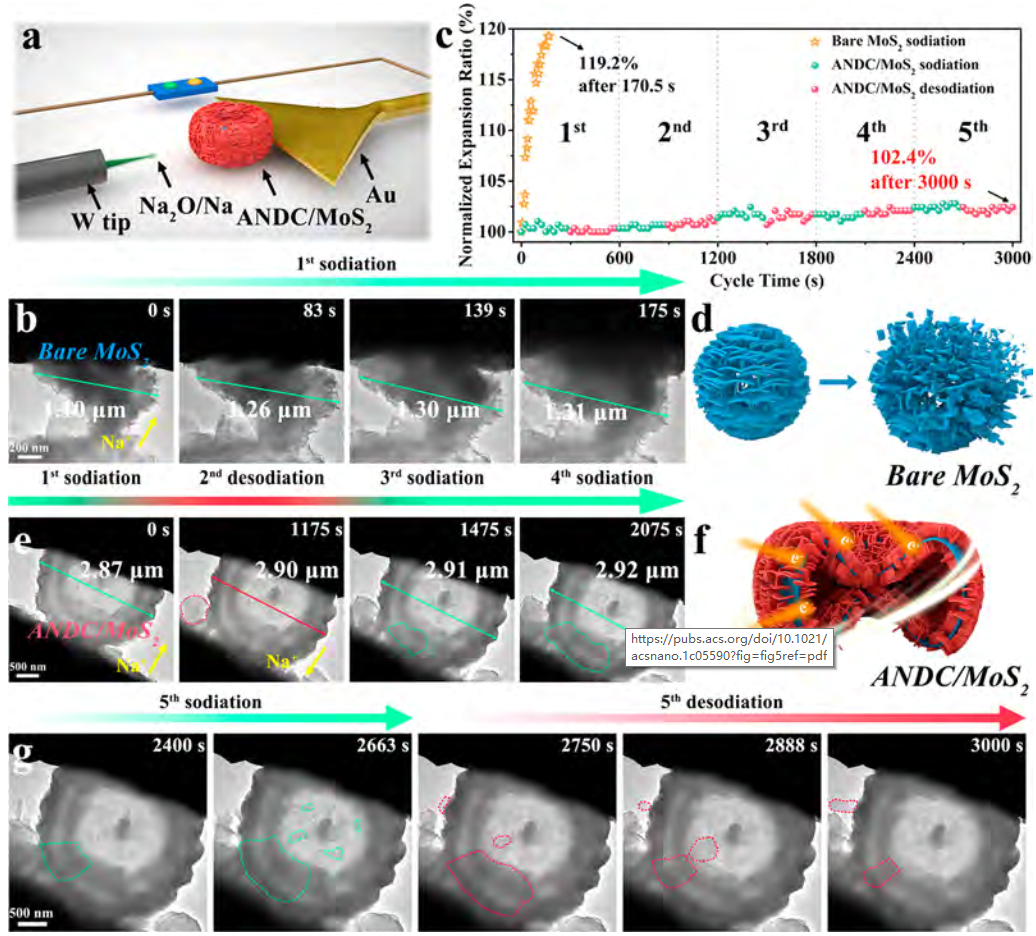
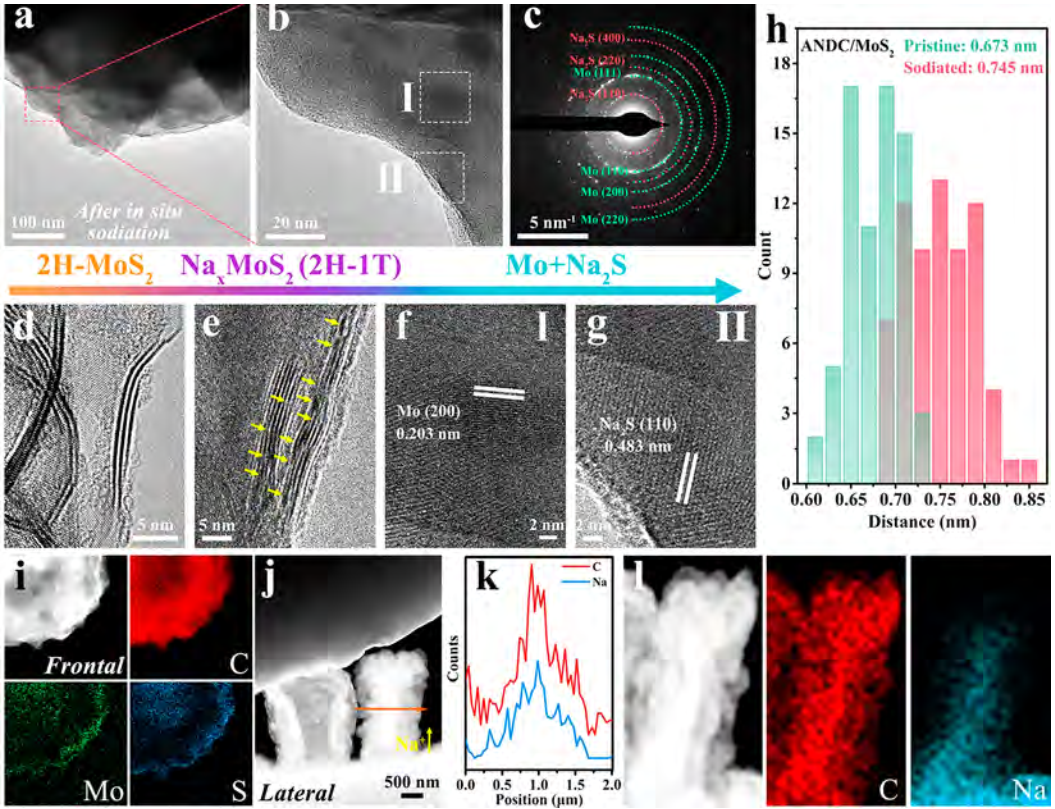
Shiyuan Zhou, Sangui Liu, Hong-Gang Liao. A “Biconcave-Alleviated” Strategy to Construct Aspergillus niger-Derived Carbon/MoS2 for Ultrastable Sodium Ion Storage. ACS Nano 2021, 15, 13814−13825
Dendrite-Free Lithium Metal Batteries Enabled by Efficient Diffusion of Ultradense Lithium Through Atomic Channels
The non-uniform accumulation of rapidly diffusing lithium on the anode surface aggravates nucleation and growth induced by the tip effect, leading to dendrite formation in lithium metal batteries (LMBs). Regulating lithium diffusion on the anode surface has previously been regarded as the mainstream strategy for inducing uniform lithium deposition, whereas lithium diffusion within the anode bulk has generally been overlooked.
Conceptually different from conventional surface modification approaches, this study proposes a molecular tunneling strategy to construct atomic channels within graphite blocks, thereby enabling the rapid diffusion of ultradense lithium. Density functional theory calculations and molecular dynamics simulations demonstrate that bulk diffusion through atomic channels can become a new dominant diffusion pathway.
In situ transmission electron microscopy (TEM) further revealed the reversible and efficient diffusion behavior of lithium through these atomic channels. As a result, when paired with a high-loading LiFePO₄ cathode (20 mg cm⁻²), the system achieved high areal capacity and 100% capacity retention over 370 cycles.
Through this work, a new strategy for developing dendrite-free lithium metal batteries based on the bulk diffusion of ultradense lithium was established, which can be broadly applied to other high-performance energy storage systems.
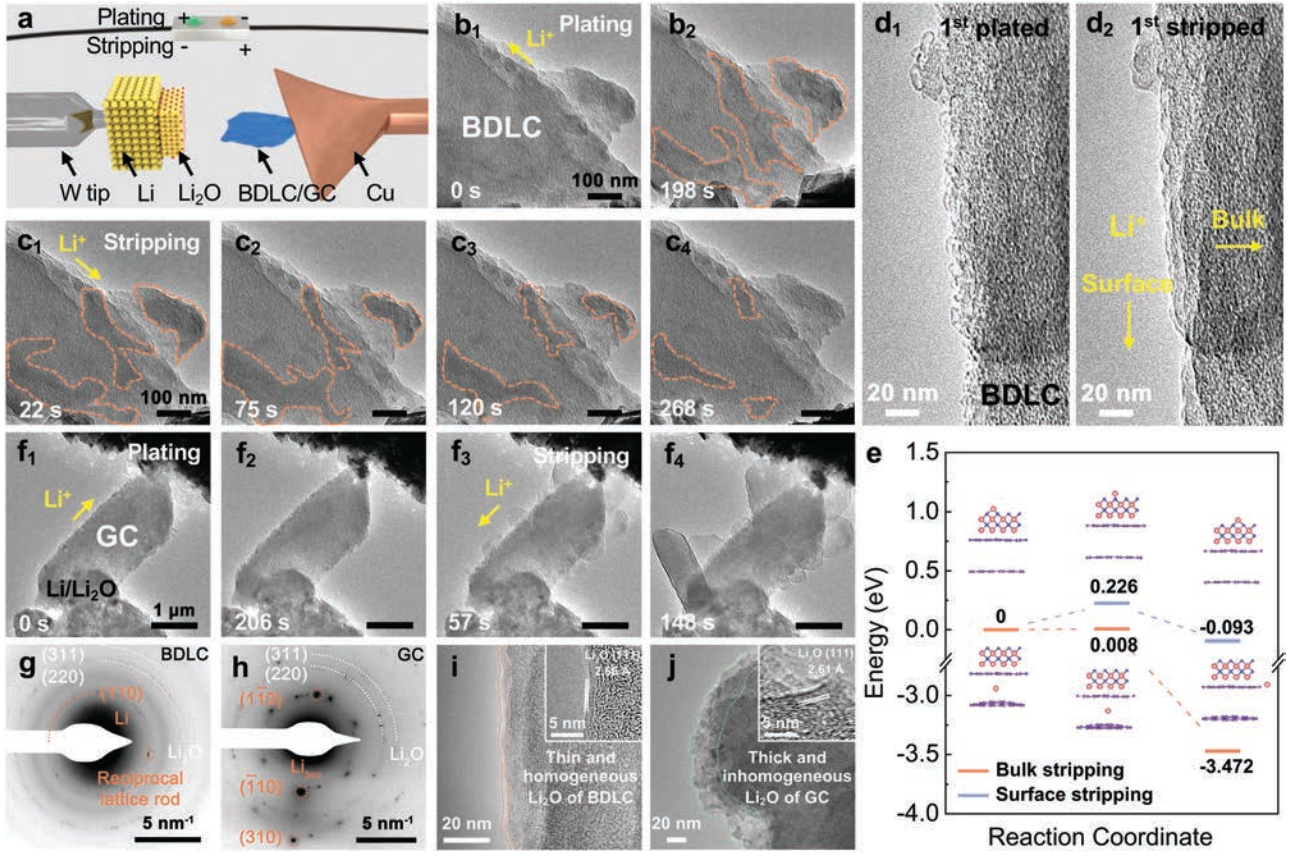
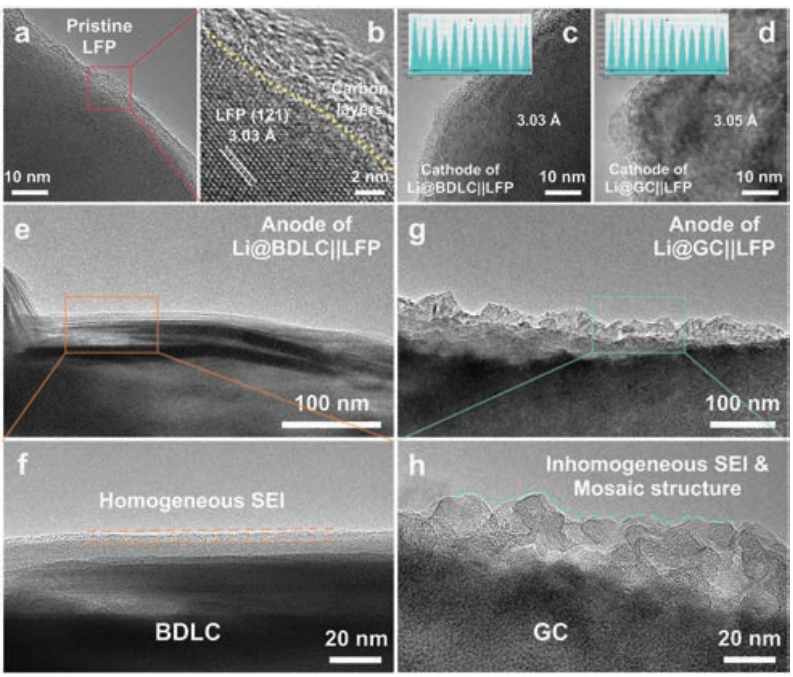
Shiyuan Zhou, Weixin Chen, Hong-Gang Liao, Efficient diffusion of superdense lithium via atomic channels for dendrite-free lithium–metal batteries. Energy Environ. Sci.,2022, 15, 196.